
Multi-Round Auctions: More from Every Impression
Kainar Kamalov
Most monetization platforms are designed to run a single auction per impression opportunity. All bidders compete once, under a single set of conditions.
CloudX takes a different approach. We give publishers the ability to run multiple auction rounds per impression opportunity, enabling more control and flexibility.
Why it matters
Waterfalls introduced sequencing, but limited competition per impression opportunity. Single auctions increased competition but at the expense of publisher control. Multi-round auctions give publishers the best of both worlds. Bidders compete head-to-head within each round, while publishers control which bidders participate in each round and under what terms.
A single auction where bid price is all that matters has the benefit of simplicity, but this simplicity comes with costs. One example: an inevitable race to the bottom in ad quality, and a subsequent hit to publisher retention. In a world where all $60 bids are treated equally, whether the ad is a 120-second non-skippable with a tricky close button or a 30-second skippable with an obvious one, the incentive structure is clear.
Many platforms that run auctions also run ad networks, meaning the auction holder is incentivized to give its own network complete and favorable access. Providing publishers with multi-round auctioning and control over buyer participation in each round may not serve the interests of the auctioneer’s own demand channel. CloudX doesn’t operate a network. We operate a marketplace platform with incentives fully aligned with our partners.
Multi-round auctions unlock things that aren’t possible in a single auction:
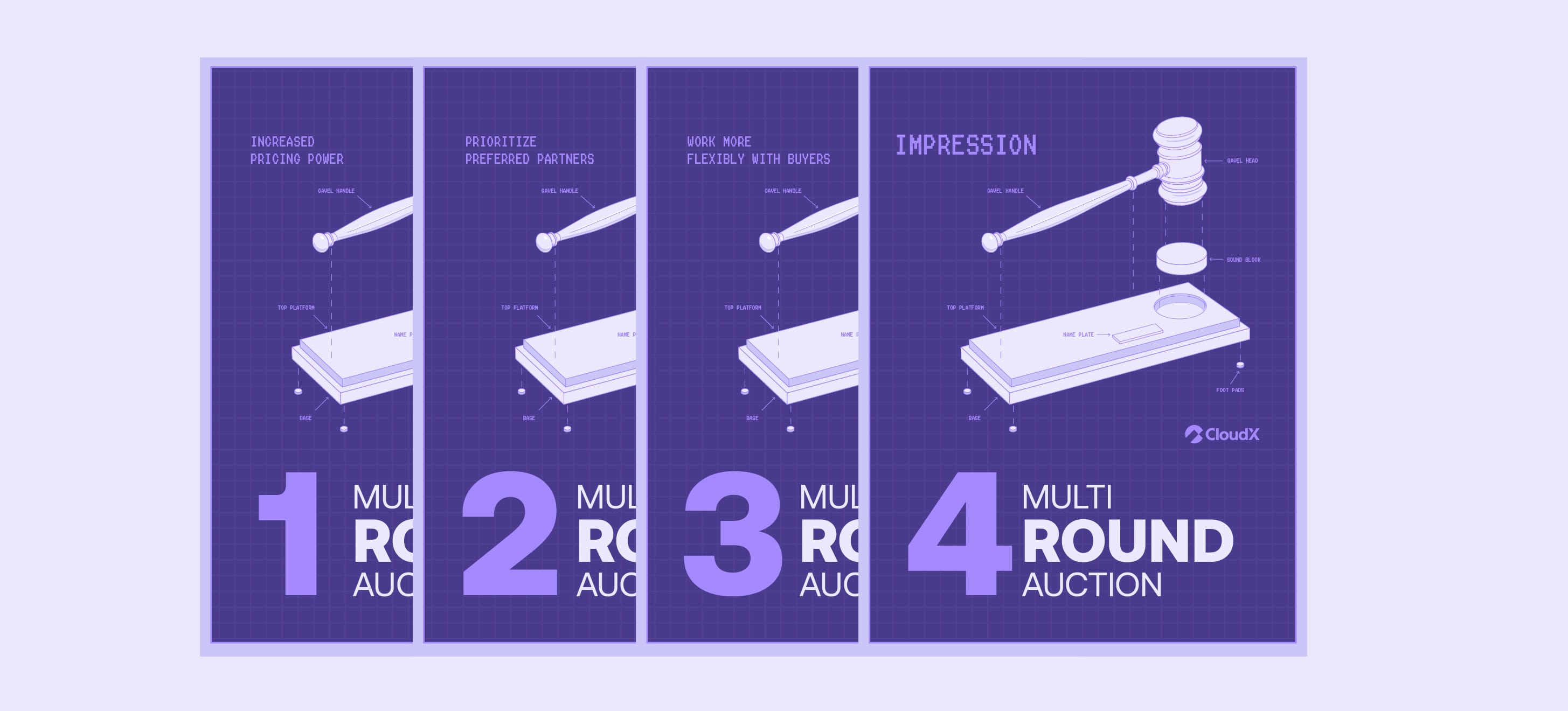
- Increased pricing power — higher-value demand competes at higher floors first. Lower-value demand is only accessed if needed.
- Prioritize preferred partners — give preferred demand partners preferred access, whether based on creative quality, strategic value, demand diversity, or any other reason.
- Work more flexibly with buyers — structure access on your terms: PMPs, first-party data sharing, custom floors. More ways to create value for both sides.
The result: publishers extract more revenue from their inventory, with the ability to optimize for factors beyond bid price — creative quality, buyer relationships, and user experience, all with LTV in mind.
How it works
Line items define the rules. Rounds execute them.
Publishers don’t configure rounds directly. They configure line items, and the system groups them into rounds automatically.
A line item is a targeting rule paired with bidder configuration: for requests matching these conditions, the system invites the specified bidders and rejects anything below the stated floor.
Each line item includes a priority (1–10), targeting conditions, a bidder list, and a bid floor.
Every ad request carries attributes: country, OS, language, connection type, session depth. Matching line items are grouped by priority, and each priority level becomes a round.
The effective floor for a round is the minimum across all line items in it:
1round_floor = MIN(li.bid_floor for each li in round)23// Every bidder in a round sees the same floor. No bidder-specific4// adjustments. This is what makes the auction fair and TEE-verifiable.
Once rounds are formed, the system executes them sequentially:
- Enter the highest-priority round
- Send bid requests to all bidders in parallel
- Reject anything below the floor
- Select the highest valid bid
If a valid bid exists, return the winner. If not, move to the next round.
Because bidding happens server-side, all requests within a round go out simultaneously. Multi-round auctions operate within latency limits set with publisher fill rates and user experience in mind.
Best of both worlds
Multi-round auctions preserve the benefits of unified bidding while giving publishers meaningfully more control over who competes, under what terms, and at what bid floor. Publishers are already seeing the benefits, and we expect these to compound as our platform continues to mature. If you’d like to learn more, reach out to hello@cloudx.io.